Robots serve popcorn as NVIDIA shows AI learning to move
The humanoids behind the counter come from the official GR00T 2 project. The widely shared footage illustrates research into transferring skills between humans and robots.
More
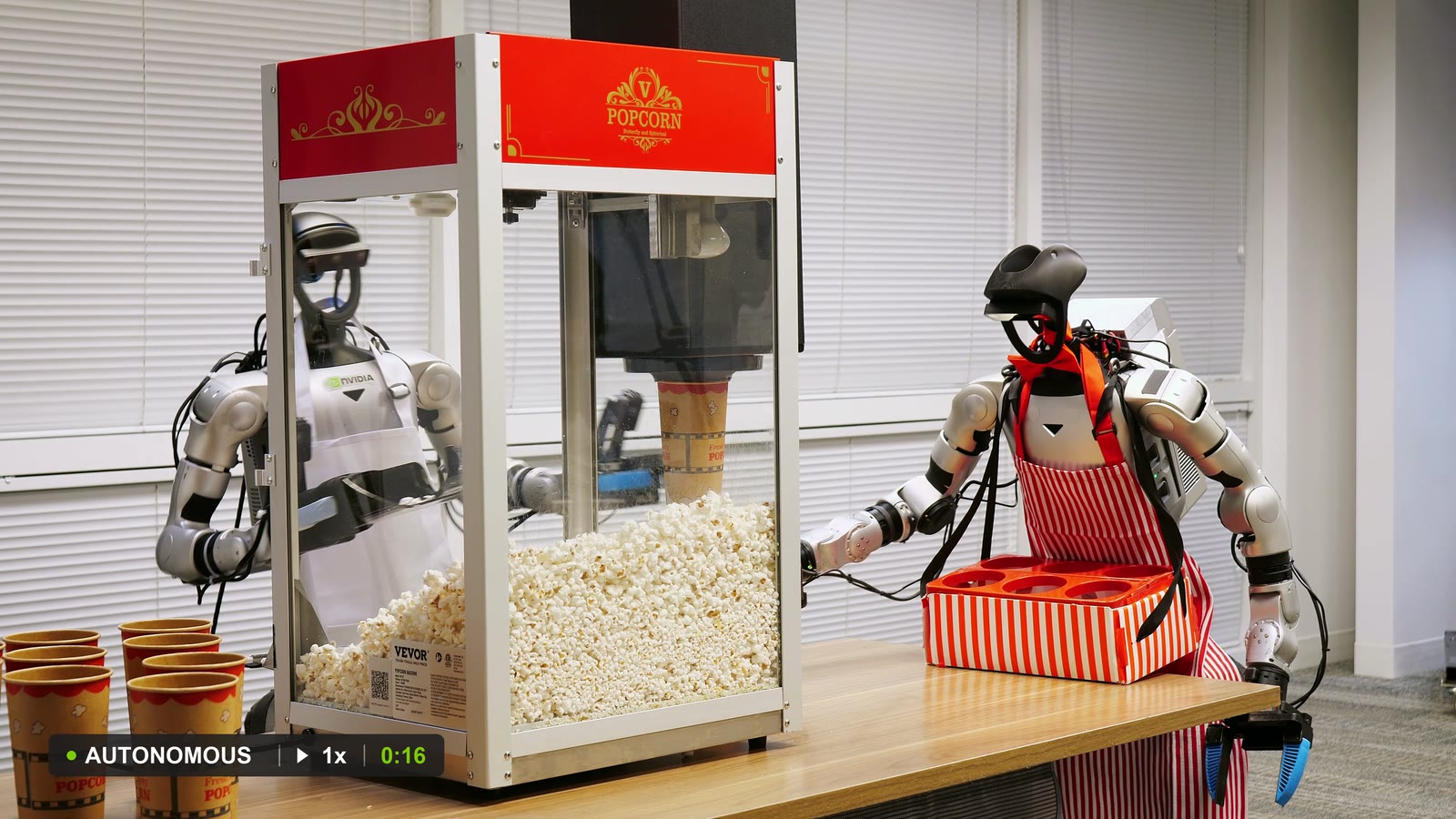
Two humanoids, a popcorn machine and a counter: the scene looks like a preview of a cinema without staff. The footage being shared on LinkedIn has an identifiable source on NVIDIA’s official GR00T 2 project page, which includes a popcorn serving and delivery video. The model was introduced on November 9, 2026. This article was updated on November 14 with the original footage and an explanation of the results.
The Unitree G1 humanoid uses the faster GR00T 2 Turbo variant with the SONIC whole-body controller. NVIDIA reports success in all 48 popcorn scooping and serving trials. This is the authors’ result for a particular task and setup. It does not mean the robot succeeds at every job or that the demonstration establishes readiness to work among customers.
What is actually being learned
GR00T 2 predicts future images and robot actions jointly. In some experiments, skills demonstrated by human hands transfer to a robot’s body. In a separate set of 50 tasks, NVIDIA reports average success of 71 percent after one demonstration per task and 95 percent after five. These are not popcorn-serving results.
The distinction between watching and performing is easy to miss. A person can show someone how to lift a cup, but that demonstration does not give a robot a ready-made list of commands for its motors. Its fingers may be different, its reach shorter and its camera higher. The demonstrated action must be connected to the capabilities of a particular body. That claim about skill transfer deserves closer attention than the charming scene behind the counter.
What the footage does not establish
Imagine the same counter during a rush. Someone moves a cup while the robot fills it, a child reaches towards the tray, or a customer changes their mind. These are questions for further testing, not events documented by this clip. Assessing practical usefulness would require knowing how the system responds to interruptions, when it hands work back to a person and how long it can operate without assistance.
The social media post therefore needs to be read on two levels. There is a real, publicly available demonstration of robotic work. The claim that robots now “understand the physical world” is a much broader interpretation. Predicting the consequences of movement can be an important technical ability, but does not by itself show that a system understands the purpose of serving someone as a person entrusted with that job would.
A humanoid serves and delivers popcorn
NVIDIA Research · 2026-11
Original manufacturer demonstration, labelled autonomous. The 48-trial result concerns scooping and serving popcorn; it does not measure the reliability of every action in the video.
Open the original video ↗AI Revolucija Analysis:
When a robot performs an everyday action, the question of artificial intelligence becomes almost tangible. We are no longer watching an answer on a screen, but a movement occupying space beside us. The meaning of trust changes too: we allow a machine to act in surroundings where someone else bears the consequences.
The ability to perform a task and responsibility for a service remain different things. A person behind a counter can notice that a customer needs help, judge a situation unsafe or suspend service. Introducing a robot requires deciding who makes those judgements. Technological progress does not remove the organisational decision about who monitors the work, who can stop the system and who answers when something goes wrong.
The most interesting future for this technology may therefore not be measured by how convincingly a robot imitates an employee. The more important question is whether it can take over exhausting, repetitive work while leaving people with more time and a real ability to make decisions. The popcorn footage offers an appealing opening to that discussion. The answer will have to be sought in working conditions as well as machine skill.
Sources and verification
About this article
Report type: VIJEST.