Why do we look for intention in a robot’s gaze?
For a technology fair in Shenzhen, Skinvers announced two robots with faces sculpted in the detail of a film prosthetic.
This article was generated using AI.
More
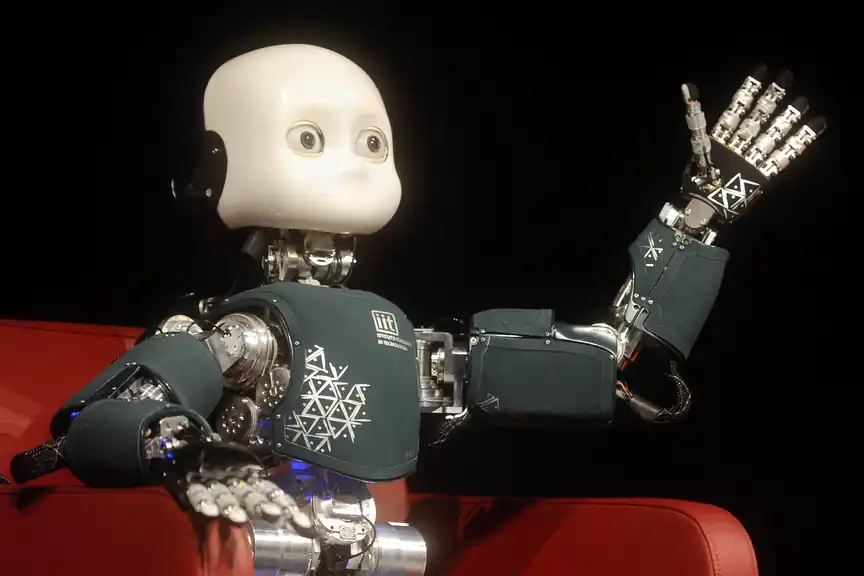
In a photograph of an exhibit bearing the names Skinvers and Prosopic, the head tilts slightly and the dark eyes look to one side. Below the chin begins a suit of red and silver armour, ending at the waist on a round base. The torso gives away how the body was made. The face holds our attention for a different reason. It is hard to look at those eyes without wondering what they are looking at.
For the 28th China Hi-Tech Fair, held in Shenzhen from 26 to 28 November, Skinvers announced two models on its Weibo account, Yao K01 and Zhao V01. Nothing in the announcement identifies which model corresponds to the red and silver bust in the photograph. Nor did the company explain in that post how the gaze is controlled or what kind of conversation the devices can sustain.
For now, more can be established about the venue than about the exhibit’s movements. The organisers held this year’s fair at an exhibition centre in Shenzhen’s Bao’an district. Skinvers and its partner listed their joint stand as 14-H26. The names Skinvers and Prosopic are visible behind the bust and on its base, linking the scene to the exhibitors. Identifying the model with confidence would take a picture of its label or direct confirmation from its maker. However distinctive the armour, it cannot settle that question.
Even the announcement gives the pair a small story: the manufacturer presents them as a hunter and the hunter’s reflection. Cinema audiences know the device. Before actors speak, a tilt of the head and the way the camera frames them can already suggest what they are about to do. A visitor standing in front of a robotic bust has another option. They can move to one side and see whether its eyes follow. The original photograph records a single instant in that possible encounter.
Two people can see the same gaze
Show the photograph to two people and one might say the robot is watching a passer-by while the other says its eyes have been set at that angle. Both saw the same thing. One explains the pose by referring to an interest in something outside the frame, the other by referring to the mechanism. The disagreement can be studied without guessing what happened at the fair. Psychologist Serena Marchesi and her colleagues devised just such a test for a different humanoid.
They showed people 34 brief scenes featuring iCub, each consisting of three photographs. Participants rated two possible explanations of the same behaviour. One appealed to the way the robot had been built or programmed. The other referred to something it might want or believe. Overall, participants leaned towards mechanical explanations, but in a substantial number of cases they also chose accounts that ascribed intentions to the robot. The kind of scene could change how someone explained a machine they already knew.
Marwen Belkaid’s team measured the difference the direction of a gaze alone could make in a study published in Science Robotics. Participants played a strategy game with iCub. When it met their eyes before they had to decide, they took longer to respond than when it looked away. The finding describes the people who took part. What iCub might itself have experienced was outside the question the game was designed to answer.
The experiments capture different moments in an encounter. Marchesi asked how we interpret a movement when we have time to look at a photograph and consider its meaning. In Belkaid’s game, someone had to decide what to do next with the robot right there in front of them. For a reader looking at the photograph from Shenzhen, the first experiment is closer to the experience at hand. The second matters when we imagine walking up to the exhibit and letting its next move influence our own.
AI Revolucija Analysis:
Who hears a confidence when a robot looks attentive?
In conversation we sometimes break off in the middle of a sentence because of the way someone looks at us. Perhaps they are waiting for us to finish. Perhaps they heard something in our words that we ourselves overlooked. We adjust what we say to allow for that possibility. Belkaid’s experiment shows that a machine can alter the timing of a human decision. A manufacturer designing a robotic face has a considerable power here. The design may shape what another person becomes willing to say.
The philosopher Daniel Dennett described an ordinary ability that serves us well every day. Sometimes the easiest way to predict what a creature or device will do is to ask what it knows and what it is trying to achieve. A chess player thinking about a computer opponent in those terms can see that their queen is under threat without knowing how the program calculates its next move. Dennett called this way of predicting behaviour the intentional stance. At a fair the same habit helps us follow an artificial face’s gaze towards an imagined event beyond the frame.
The difficulty begins when we read a promise into a successful prediction. I might correctly anticipate that a robot receptionist will incline its head when I lower my voice and still be quite mistaken about whether anyone will take my words seriously. In the first case I have learned how a device behaves. In the second I am laying claim to the consideration of another person or institution. Human experience has taught us that the two often go together. Someone who makes an attentive face can uncouple them without a user noticing where the connection broke.
Imagine that face at a hotel reception desk. A guest confides that they need another room because they are afraid of someone. Who heard that sentence? Will it reach a person who can help? In the attentive look the guest may have read discretion and the promise of help. Both need someone able to honour them. The more convincing the face, the more important it is that people can find out whom they are addressing before they say what they can never take back.
Choosing a face like this also calls for listening to people for whom it might make a difficult conversation easier. A guest might approach a machine precisely because they expect no judgement. That experience has value. What would matter to that guest just then is a brief, truthful explanation of whether a member of staff will see the message and whether it can be passed on in confidence. The hotel takes on a responsibility the moment the face and manner of its reception invite a guest to confide.
A visitor at a fair can return the gaze and walk on to the next stand. At a clinic, a bank or a town hall, such a figure might one day be the first, perhaps the only, point of contact at the door. Freedom of choice then takes on a very practical meaning. Can someone who has already begun explaining a problem to the robot ask for a person, carry the conversation over and get an answer in time for it to help?
Sources and verification
- Skinvers · announcement of the models and joint stand on Weibo (Chinese) ↗
- China Hi-Tech Fair · official information for the 2026 edition ↗
- Marwen Belkaid and colleagues · Science Robotics, 2021 ↗
- Serena Marchesi and colleagues · how people interpret humanoid behaviour ↗
- Daniel C. Dennett · The Intentional Stance, MIT Press ↗
About this article
Report type: News report.