
Robotics · Paper review
A robot face with living skin really can smile. What did the Japanese experiment establish?
Cell Reports Physical Science · Peer-reviewed paper · archival research review · 25 June 2024 · 3 min readBy: AI Revolucija editorial team
IN BRIEF
- University of Tokyo researchers built a robotic face display whose surface of living cultured tissue moves into a smile-like expression.
- The paper was published on 25 June 2024 and presented by the university the following day.
- The 2024 experiment demonstrates mechanical shaping of living tissue.
What the research shows
University of Tokyo researchers built a robotic face display whose surface of living cultured tissue moves into a smile-like expression. The paper was published on 25 June 2024 and presented by the university the following day. The biohybrid experiment addressed how to attach soft tissue to a moving support.
Shoji Takeuchi’s team addressed a specific engineering problem. Soft tissue must attach to a rigid surface while following its movement. They drew inspiration from the ligaments connecting human skin to underlying structures. Small perforations in the substrate allow collagen gel to enter and form anchors.
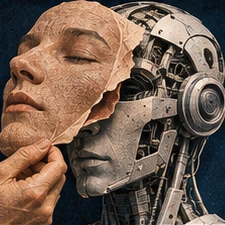
The study describes a three-dimensional facial mould covered with a skin equivalent and a separate, simpler smiling robotic face using a dermis equivalent. Moving its anchors deforms the tissue. The original research image shows a pink laboratory construction. The realistic humanoid face in the viral post is not a photograph of that prototype.
Living tissue interests researchers partly because of its potential for biological repair and future integration with sensing. This paper does not demonstrate a finished humanoid that autonomously maintains and repairs an entire skin covering. The authors identify further challenges, including a thicker epidermis and structures such as blood vessels and nerves. The tissue needs conditions that keep it alive.
The smile demonstrates that biological material can be mechanically shaped into a recognisable expression. The experiment did not investigate a robot’s emotional experience. Its findings concern biohybrid robotics and materials research, with possible uses in skin research and medical models.
Scope and limitations
The 2024 experiment demonstrates mechanical shaping of living tissue. It does not investigate feelings, consciousness or human sensory experience in a robot.
AI Revolucija analysis
In a human encounter, a smile carries the promise of someone on the other side. We look for a mood, an intention or a response to our presence. When laboratory-grown tissue is moved into the same shape, the visible sign remains familiar while the question of its bearer becomes unsettled. Living cells alone do not establish a subject experiencing joy.
It would therefore be a mistake to infer the humanity of an entire system from the human origin of its material. Yet appearance also has ethical weight. If a future care robot’s expressions encourage a vulnerable person to attribute understanding to it, responsibility already arises in the relationship the design creates. That responsibility need not wait for an answer about machine consciousness.
Biohybrid robotics also raises questions about our treatment of tissue. Donor consent, the origin of cells and the justification for their use should remain visible behind an impressive demonstration. Ethical progress cannot be measured only by how closely a machine resembles a person. It also depends on whether a project protects the dignity of those who supplied the material and the freedom of those who will live with the system.
A question to consider
What do we attribute to a smile before we understand how it was produced?
Original publication
Perforation-type anchors inspired by skin ligament for robotic face covered with living skin
Michio Kawai, Minghao Nie, Haruka Oda and Shoji Takeuchi
Cell Reports Physical Science · 25 June 2024
FACT CHECK
Checked on 14 November 2026 against the original paper, university announcement and laboratory page.