
A robot that cosmonauts will operate has reached the space station
Russia’s Teledroid will first undergo tests inside the station before the crew is due to mount it on the outside of the Nauka module.
This article was generated using AI.
More
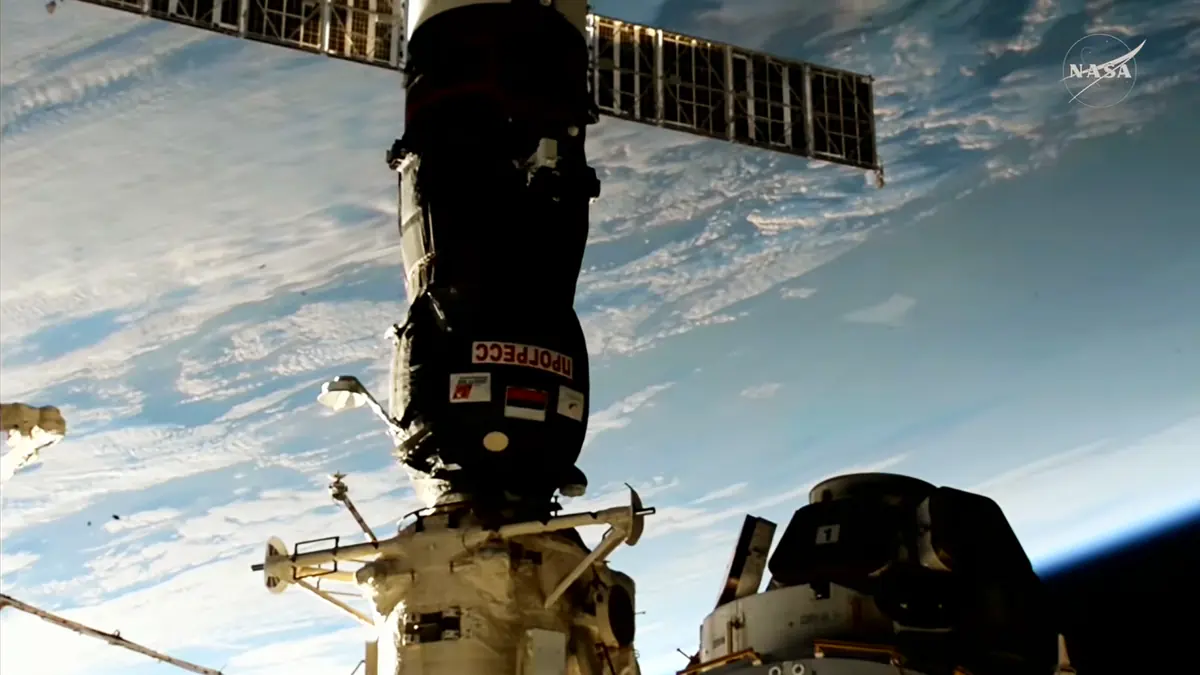
The Russian robot Teledroid arrived at the International Space Station on 26 November aboard the Progress MS-36 cargo ship, together with supplies for the crew. It is intended to work outside the station while its operator stays inside. Before that can happen, two cosmonauts will have to go outside and install it.
Progress had launched two days earlier from the Baikonur Cosmodrome in Kazakhstan. NASA confirmed its docking at the Rassvet module and put the cargo at about three tons. Russia’s TASS news agency named Teledroid among the equipment delivered. Part of the system was already in orbit. A previous cargo ship had delivered the exoskeleton in September, a device the cosmonaut wears to control the robot.
The docking itself offered the crew a lesson in dividing work between people and machines. Progress made its final approach automatically, with cosmonaut Pyotr Dubrov standing by inside the station to take manual control if necessary, according to RussianSpaceWeb. Dubrov thus helped receive a device that might one day assist him outside. In both cases a machine can carry out part of a manoeuvre while a person must understand what is happening early enough to intervene.
Before the robot gets a job outside, the crew will practise a series of almost ordinary actions inside. They will take an object from storage, simulate handing over a tool and put it away again. The planned handover will be simulated without direct contact with a cosmonaut. Anyone who has ever held a tool out for someone knows the distinction. Grasping the handle is one skill. Judging when the next person has a secure grip is another.
A seemingly simple job makes it possible to pinpoint what went wrong. The robot might select the right tool and hold it at an angle that makes it hard to take. It might also get a perfect grip on the wrong object. Inside the station, the crew can inspect the position of the tools afterwards and compare what they saw with what the camera showed. Only then does calling an attempt a success have a precise meaning.
Who guides the hands in orbit?
Teledroid was built by Russia’s Android Technic, and the experiment is led by the TsNIIMash research institute. Cosmonaut Anna Kikina trained on the robot on Earth. Under the plan Roscosmos outlined to Interfax, she and her colleague Pyotr Dubrov are due to install the external part on the Nauka module. The crew can then test different ways of controlling it. In one mode an operator directs the movements. In another, the operator sets a task and lets the robot use its camera to recognise a tool. The delivery makes that comparison possible.
Russian cosmonauts have tested a humanoid helper in orbit before. In 2019 FEDOR travelled to the station, where the crew tested its controls and how well a person could guide fine movements in weightlessness. The new programme adds a more demanding arrangement. Progress also brought the mounting platform for the outside of Nauka. If the experiments go to plan, the crew will guide a pair of hands working in conditions quite unlike those around the operator.
The station already has a machine that can save crew members a trip outside. Canada’s Dextre can replace an exterior camera or a component in the electrical system. An especially revealing part of Teledroid’s job will be the bit that is hard to specify beforehand, such as what happens when a tool fails to end up where the operator expected. That is when it matters what someone watching from a distance can infer, and how quickly they can change course.
Dextre’s operators can be a continent away from the place where their commands take effect. The Canadian Space Agency says Dextre is always operated from the ground. At mission control in Longueuil, a team can plan and simulate its movements and oversee the operation while the station crew gets on with other work. That experience suggests a useful measure for Teledroid. Alongside any time the robot saves a person in orbit, record the preparation people had to do to make the saving possible.
AI Revolucija Analysis:
How much dangerous work does a robot really take on?
When an exterior camera shows a metal hand picking up a tool, the human hand guiding it can disappear from the story. Yet where that human hand is located is the most important change Teledroid promises. A cosmonaut can extend a skill a few metres farther, across the wall that protects them. If it works, the person can remain involved in the job without having to expose their body to its dangers.
When we say a machine has taken over a dangerous job, we tend to picture a worker who has stepped back to safety. In orbit the benefit is plain. Responsibility may still lie with the person who stepped back. They must decide how much the camera can tell them, whether a colleague is ready and whether the tool is as steady as it looks. It would be unfair to hold someone responsible for that decision if the system no longer lets them see what they need to know to make it.
The British psychologist Lisanne Bainbridge described the difficulty in 1983 while examining automated industrial systems. The more dependably automation handles the routine, the fewer chances the operator gets to maintain the manual skills an exception will demand. The hardest moment can fall to the person who has spent the previous hours watching. On the station that insight suggests a straightforward question about training. Does the operator get to practise recovering from a failed manoeuvre as thoroughly as executing a successful one?
The value of this work can be tested. For a well-defined task the crew could count the time spent outside installing, maintaining and, if necessary, repairing the robot. They could compare that total with the time that a series of direct spacewalks would have required. One successful movement on camera tells us little about whether, several months later, the crew’s exposure has fallen.
Those records could miss something important. A first-time operator might ask for another view before moving the arm. An experienced colleague might see all they need in the first frame. If the report reduces both performances to an average completion time, it loses the information about how much expertise the machine needed to look self-sufficient. That may be precisely what the people taking over from the present crew most need to know.
It matters just as much to record the moment an operator decides to stop. Someone might have spotted a tool shifting at the edge of the frame, or a colleague standing too close. Calling off a dangerous manoeuvre on that judgement is good work, even if the job remains unfinished. A space experiment could have something to say about workplaces back on Earth if its record of successful operations also has room for those human decisions.
Sources and verification
- NASA · Progress 97, 26 November ↗
- TASS · Progress MS-36, 26 November ↗
- Interfax · Roscosmos on Teledroid ↗
- Canadian Space Agency · Dextre’s work ↗
- Anatoly Zak · the cargo and docking of Progress MS-36 ↗
- Canadian Space Agency · who operates the robots in orbit ↗
- Lisanne Bainbridge · Ironies of Automation, Automatica, 1983 ↗
About this article
Report type: News report.