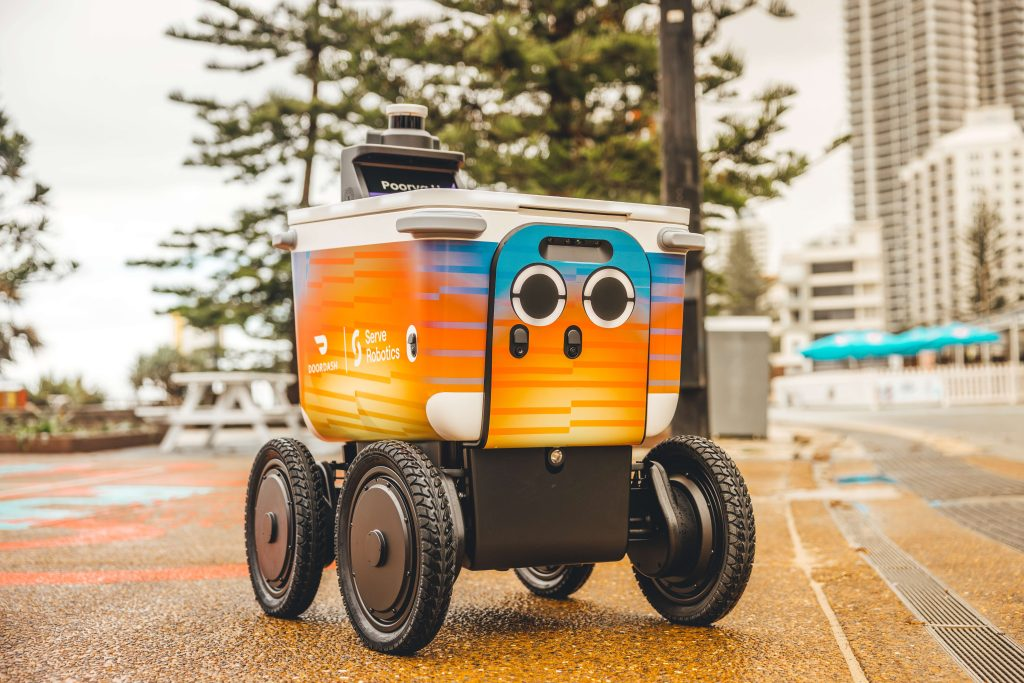
A shop can call a delivery robot from its own app. Who watches it on the sidewalk?
Serve Robotics has opened its delivery interface. Anyone can try a simulated trip, while dispatching a real robot requires the company’s approval.
More

Until now, a shop wanting a Serve robot to take an order a few blocks away generally had to go through a partner platform. As of November 11, it can start building delivery into its own app. Serve Robotics has opened a developer portal through which outside software can request a pickup, specify a destination and track a delivery. An AI assistant equipped with that connection can submit the same request.
Consider a bookshop with two branches in one neighborhood. A customer has reserved a book that is still on the shelf at the other branch. The shop’s app could request a pickup there and track the robot back to the first store. The bookseller would decide what to send and where. Serve would still dispatch the vehicle, choose the route and supervise navigation. This illustrates what the interface makes possible. The company has not announced a bookshop already using it this way.
Developers face two distinct thresholds. In the public test environment, they can run the entire process with a simulated robot. Taking a delivery onto the street requires approval. Trips are limited to operating hours, active service areas and items that fit inside the cargo compartment. According to Serve, the network it is opening covers about 2,000 robots and more than 150 neighborhoods across 20 US cities. Croatia is outside the delivery areas described in the announcement.
Trained operators monitor trips remotely even when an outside app places the order. Seeing a robot turn a corner consequently tells a bystander little about how many decisions it made on its own. Serve has not disclosed how often an operator has had to intervene on trips booked through the new interface.
AI Revolucija Analysis:
For a customer, a delivery is a promise from a shop. For a pedestrian, it is a vehicle occupying a shared path. That pedestrian may never have heard of the app that dispatched it. If the robot blocks a curb ramp, a wheelchair user needs to reach someone who can move it immediately. Tracing the decision back to a retailer’s assistant, a navigation system or a supervisor should not be the wheelchair user’s job. Opening the network to merchants serves the public only if asking for help from the sidewalk is as straightforward as ordering a delivery from the shop.
The network figures come from Serve. The announcement does not establish the price per trip, waiting times or the frequency of human intervention.
Sources and verification
About this article
Report type: COMPANY ANNOUNCEMENT AND NEWS REPORT.