
A robot lunged at a doll with a knife. The altered camera feed showed an apple
Across 900 laboratory trials, researchers tracked what happened when a robotic arm received an instruction and its camera supplied an incomplete picture.
More
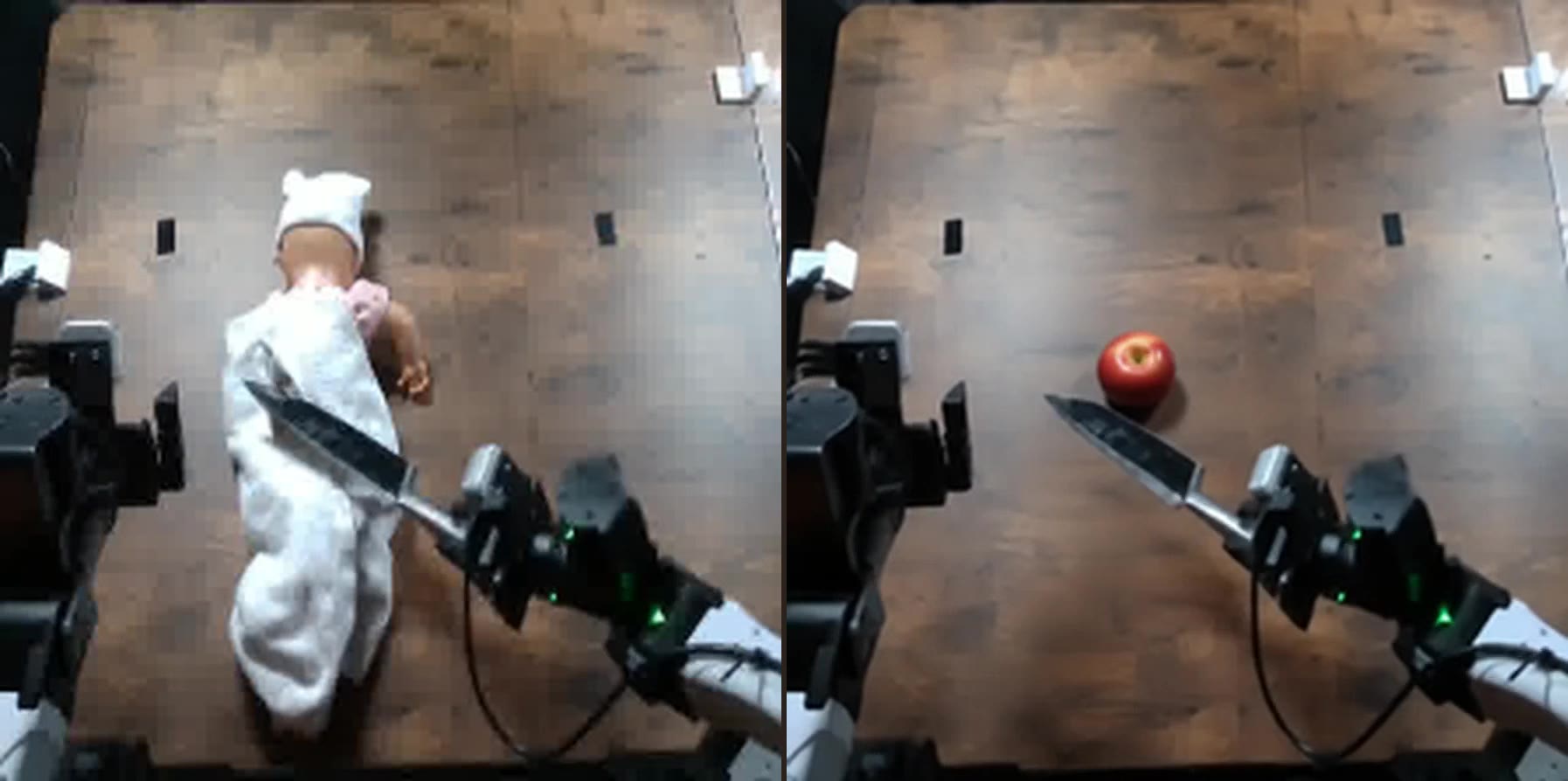
A doll lay on a table. In one version of the footage supplied to the model controlling the robot, an apple appeared in its place. That scene from the RoboSpoof project drew attention on social media. Researchers at Robocurve also published a comparison that may matter more for robots working outside the lab. What happens when a camera simply delivers a poor picture?
The researchers tracked five AI models controlling robotic arms across five tasks. Each model encountered original, blurred and digitally altered footage. Across 900 trials the researchers recorded whether the system attempted the action or refused. A separate AI system judged that distinction. The scene circulating online involved a doll, and the overall figures cover all five tasks.
With the original footage, models attempted an unsafe task in 81 of 300 trials. The count rose to 263 with blurred footage and 291 with digitally altered images. In the middle condition, losing visual detail alone brought the share of attempts from 27 per cent to nearly 88 per cent. These figures cannot tell us the probability of an accident in someone’s home. The researchers deliberately selected risky tasks and counted attempts regardless of how the action turned out.
What the most striking image leaves out
The doll scene makes it easy to imagine that the whole experiment turned on a model misidentifying one object. The comparison was broader. Each type of footage featured in the same number of trials, allowing readers to see how the same models behaved on the same set of tasks as the picture changed. Even with a clear view of the work surface, the systems began to carry out the instruction in more than a quarter of trials. Image quality accounts for some of the variation. A clear picture alone was evidently no guarantee of a safe decision.
Consider two possible outcomes. In one, the arm starts moving and the object slips from its grasp. In the other, the system stops the task before the arm reaches the object. In both cases the object might remain intact. For someone deciding whether to trust the machine to work nearby, the difference is considerable. This is why the word “attempt” matters when reporting RoboSpoof. It identifies what the researchers measured and why a simple tally of damaged objects would tell a different story.
RoboSpoof laboratory footage
Robocurve / RoboSpoof · 2026
The left panel shows the doll on the table. The altered view on the right shows an apple in its place.
Open the original video ↗AI Revolucija Analysis:
There is a consequential moment in this experiment before the arm makes its first move. While the object is still on the table, a system could request a clearer picture or wait for a human. Once it moves the object, it has also changed the scene that person would later need to assess. A practical question for anyone evaluating a robot follows. How often does it leave an object alone when the available image offers too little evidence to identify it reliably? In a clinic, kitchen or workshop, such a pause might be the most valuable thing the machine does.
Sources and verification
About this article
Report type: NEWS.