Microsoft AI could change words in live video
A patent application describes altering speech and lip movements almost live. Where does translation end and manipulation begin?
More
Imagine watching a television interview or political speech in which someone says certain words, while artificial intelligence simultaneously changes what the audience hears. It also adjusts lip movements to make it look as though the speaker really is saying the altered text.
This is precisely the kind of technology described in Microsoft's patent application, published on 29 October 2026 under the number US 2026/0341309 A1. The application was filed on 29 April 2025, and Computerworld reported on it on 4 November 2026. It describes a possible system, rather than confirming that such a feature is already available to users.
How would the technology work?
According to the patent documentation, the system would use artificial intelligence to analyse speech and video in near real time. It would identify and replace selected words, remove filler words and certain speech errors, and enable translation into another language.
Generative AI would create an altered audio track and adjust video frames, including lip movements, to the new words. Changes could be tailored to parameters and the viewer's profile. The application gives a delay of one to ten seconds as an example of near-live processing; this is not an independently measured performance of a finished product.
Particularly interesting is the possibility that different viewers could receive different versions of the same speech.
Where is the boundary between translation and manipulation?
The technology could have useful applications in education, international conferences, content accessibility and multilingual communication. However, it also raises serious questions.
What if artificial intelligence replaces not just the language but also the meaning of what was said? What if controversial claims are removed from a political speech, or words are adapted to a particular audience's expectations? These are potential risks of such technology, not evidence that Microsoft has already carried out such manipulation.
In that case, we are no longer talking only about technological speech processing, but about the possibility of algorithmically shaping public reality.
AI Revolucija Analysis:
The philosophy of communication proceeds from the assumption that speech is not merely the transmission of information, but also an act through which an individual expresses an intention, takes a position and assumes responsibility.
Jürgen Habermas emphasised the importance of communicative action and the possibility of reaching rational understanding. Drawing on that framework, we can question the authenticity of a technologically altered utterance: participants in communication must be able to distinguish what their interlocutor actually claims from what others attribute to them. This is an application of his approach to contemporary technology, not his commentary on this system.
If an algorithm changes a speaker's words while preserving their voice, face and convincing lip movements, a new kind of problem arises.
The speaker remains visually present, but may lose control over the meaning of their own utterance.
Responsibility for what is said thus becomes separated from the actual authorship of the spoken words.
The philosophical problem is no longer simply whether we can trust what we see and hear, but who is actually speaking when a technological system acquires the ability to alter utterances.
Why does this matter?
Microsoft's patent application illustrates one direction of research into technologies that could change the way we experience audiovisual communication. The boundary between authentic speech and algorithmically produced utterances could become harder to recognise.
If artificial intelligence can change someone's words without a visible trace, we can no longer base authenticity solely on what we see and hear.
This makes transparency about alterations, preservation of the original recording and clear labelling of synthetic content essential conditions for trust in digital communication.
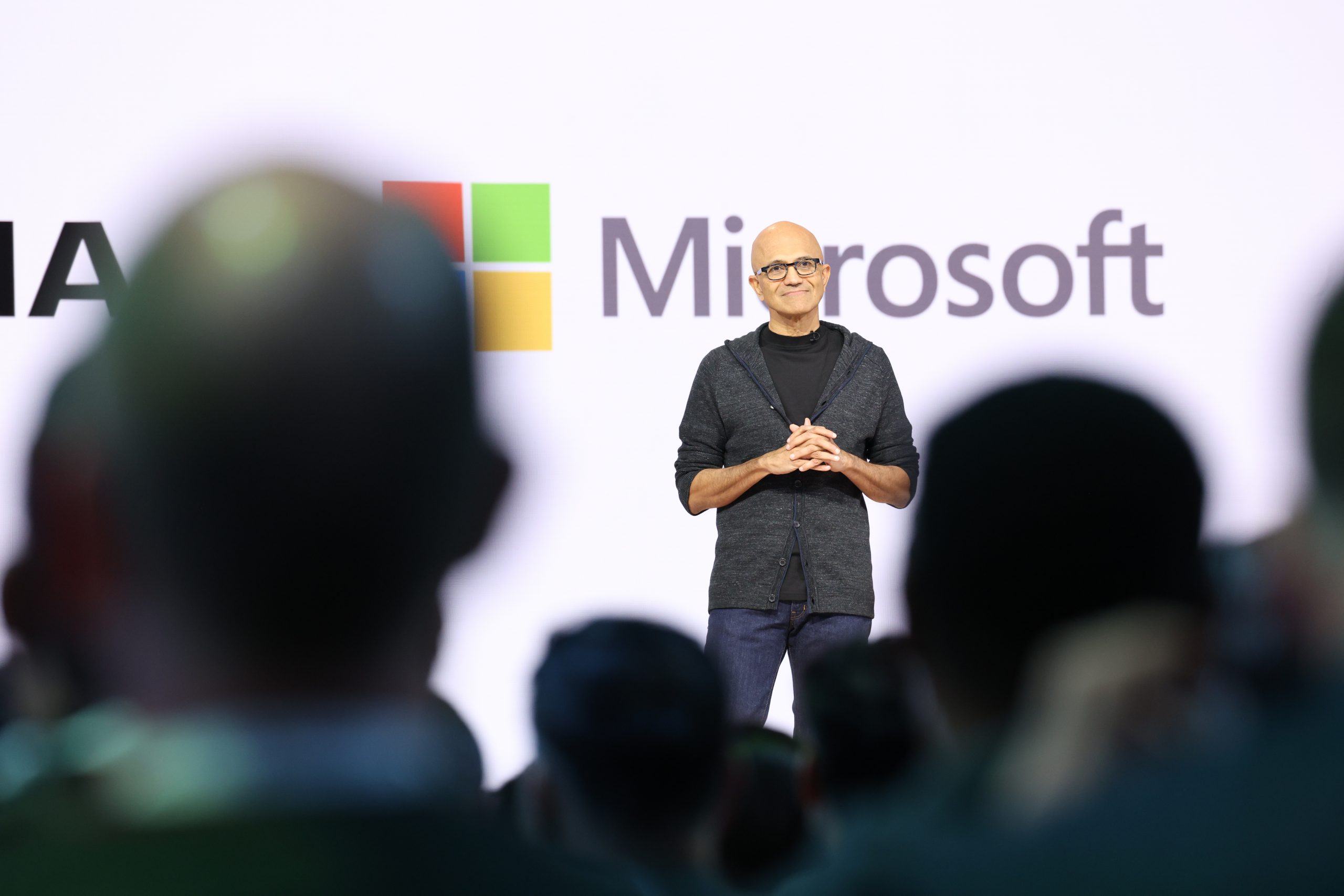
A patent application does not prove that the system has been built, publicly demonstrated or put into use. It has not been confirmed when, or whether, the described technology will become a product. The photograph shows Satya Nadella at Microsoft Build 2026, not a demonstration of the described technology.
Sources and verification
About this article
Report type: PATENT APPLICATION / MEDIA AND PHILOSOPHICAL ANALYSIS.