
Gabi the robot takes five vows before Buddhist monks in Seoul
Hong Min-suk voiced the robot, whose vows included a promise to obey humans.
More
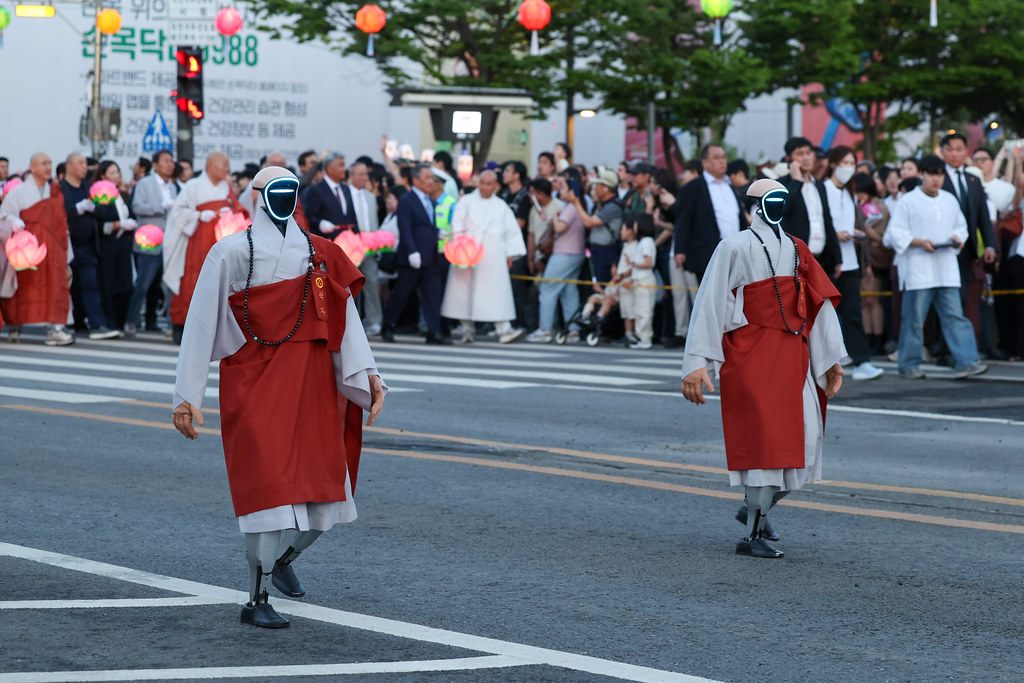
Gabi, a humanoid robot, pressed its palms together and bowed before monks at Jogyesa Temple in Seoul on 6 May 2026, the first time a robot had taken part in this Buddhist rite in South Korea. Under a canopy of paper lanterns, a monk hung a string of 108 prayer beads around its neck. At the point in the ceremony when a glowing incense stick briefly touches the skin of the forearm, he placed a Lantern Festival sticker on Gabi’s metal arm.
Gabi stands about 130 centimetres tall. Beneath the grey monastic clothing and brown ceremonial robe is a G1, a humanoid made by the Chinese company Unitree Robotics. Korea’s Jogye Order of Buddhism organised the ceremony ahead of the Buddha’s birthday. Watching the footage, it is easy to take Gabi for a new monk. The order described a rite in which lay Buddhists, too, can receive the precepts. Seong Won, the monk in charge of cultural affairs for the order, explained that Gabi’s name evokes both the Buddha and the compassion the organisers hoped people would associate with the robot.
Five rules for living among humans
The five precepts the organisers adapted for Gabi say a great deal about what they had in mind. The robot promised to respect life and to harm no living being. It agreed to avoid damaging other robots or objects, to obey humans and to refrain from defying them. It pledged to avoid misleading anyone by word or deed. The final precept could only have been written for a battery-powered monk. Gabi was to conserve energy and avoid overcharging. Seong Won told The Guardian that he had drafted the rules himself and then tested them with ChatGPT and Gemini.
The exchange the audience heard took considerable human preparation. According to The Next Web, Hong Min-suk of the Jogye Order had recorded the replies in advance, and the robot was operated by remote control throughout the ceremony. Ten days later, robot monks joined Seoul’s traditional lantern parade. One father told Reuters that his son had been thrilled to see them. He hoped the encounter would draw others to Buddhist traditions. For that family, at least, the organisers’ idea seems to have worked.
Playing loads YouTube. · KOREA NOW / Yonhap News Agency ↗
Gabi receives five precepts at Jogyesa Temple
KOREA NOW / Yonhap News Agency · 2026-05-07
The ceremony took place in Seoul on May 6, 2026. KOREA NOW released this video on May 7. An operator controlled Gabi’s gestures remotely, and the replies were prerecorded.
Open the original video ↗AI Revolucija Analysis:
Gabi’s hardest moment would come if someone gave it an order that would harm another living being. Keeping its first promise would then mean breaking its third. A person in that position could refuse to obey, explain why and take responsibility for the decision. In the temple, the precepts were read out one at a time. It was possible to say yes to each of them. Outside the ceremony, it is when two legitimate demands collide that judgement begins to matter.
In an early Buddhist discourse the Buddha connects moral action to the intention from which it springs. From that perspective, the ceremony in Seoul may also be understood from the audience. A temple bell can call a person to mindfulness without anyone attributing mindfulness to the bell. Gabi is more complicated because we hear the promise in the first person. While we try to decide whether a machine can really promise to harm no one, a more personal question can slip by. How willing are those of us who understood the words to change our own conduct when keeping that promise costs us something?
That is reason to listen once more to the voice coming from Gabi. A human being spoke the promise. Other people chose the rules. The machine bowed before the audience. With everyone together in the courtyard, it was easy to see who stood behind each gesture. If a similar robot one day finds itself alone with someone who needs help, those people will be out of sight. A human promise might then matter more than any pledge of obedience from a machine. We should be able to find out who answers for what the robot did in our name.
Gabi’s replies were prerecorded. The ceremony did not test how the robot would decide between conflicting instructions on its own.
Sources and verification
- Buddhist sect welcomes humanoid robot Gabi with precept ceremony · Yonhap, 6. 5. 2026. ↗
- Meet the robot monk · The Korea Herald, 6. 5. 2026. ↗
- I, robe-ot · The Guardian, 8. 5. 2026. ↗
- A $13,500 Unitree robot was ‘ordained’ at Seoul’s Jogyesa Temple · The Next Web, 11. 5. 2026. ↗
- Robot monks lead South Korea’s Lotus Lantern Festival · Reuters, 16. 5. 2026. ↗
- Aṅguttara Nikāya 6.63 · intention and action ↗
About this article
Report type: ROBOTICS AND SOCIETY.