
A robot lifted a medical mannequin from bed to wheelchair unaided
The mannequin weighed 15 kilograms. Nobody guided the arms of Japan’s AIREC humanoid during the transfer.
More
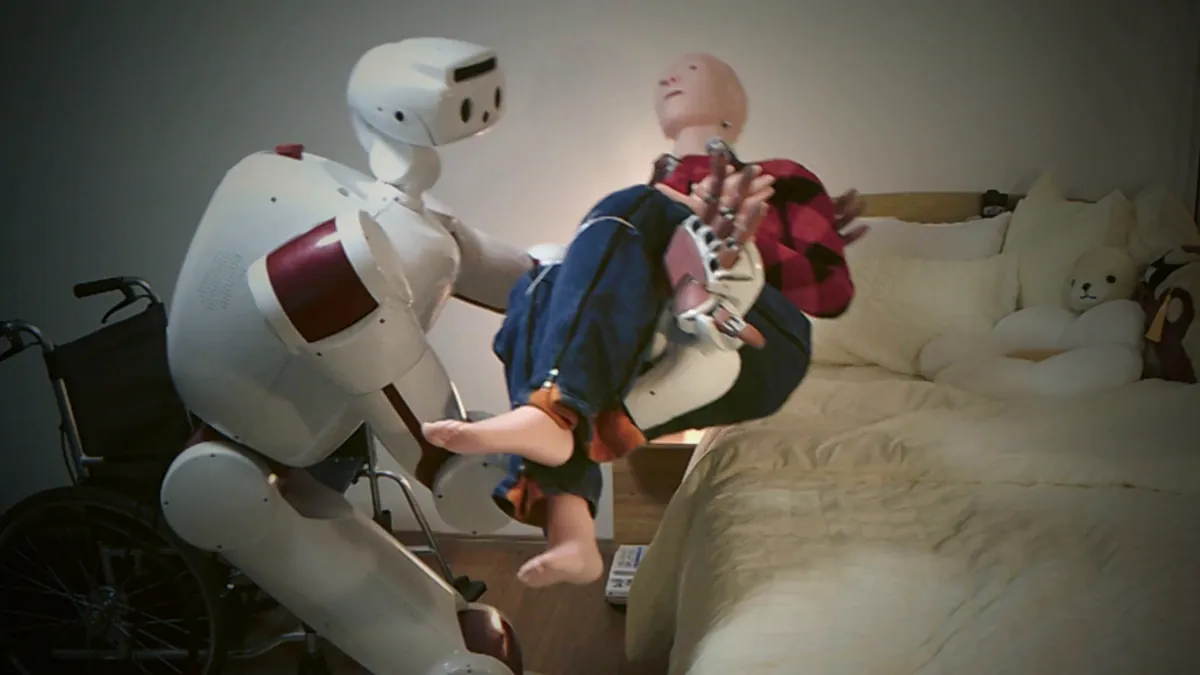
The distance between a bed and a wheelchair is sometimes less than a stride. For someone whose legs cannot bear their weight, it can be the hardest journey of the morning. Researchers entrusted that journey to a Japanese humanoid called AIREC. It reached under a medical mannequin, lifted it from a bed and lowered it into a wheelchair. An international team including researchers in Edinburgh and at Japan’s Waseda University described the experiment in a paper posted on arXiv on 22 November. Elle Miller is its first author.
A box can be gripped on either side and counted on to hold its shape. Try imagining the same thing with a human body. Knees bend, legs hang and a turn can shift the load from one arm to the other. The researchers began by letting a computer model of the robot try movements in simulation. They could vary the size and weight of the body and study what happened if an unexpected force acted on it during the transfer.
The physical AIREC, a humanoid on wheels developed for research into care, then carried out a trajectory learned in simulation. The mannequin was 155 centimetres tall and weighed 15 kilograms. Its wrists and knees were loosely bound to make the transfer easier. The team also showed the reverse journey from wheelchair to bed. Nobody steered the robot’s arms as it moved.
That last detail can easily raise expectations beyond the experiment. The physical robot replayed a practised movement, and even the same trajectory does not always succeed, the authors caution. Its shoulder strength is another constraint. The team has yet to show that AIREC can safely lift a 50-kilogram adult or adjust its grip when someone flinches in pain. For a carer looking for help in getting a patient out of bed, those are ordinary working conditions.
The experiment with a medical mannequin
Elle Miller et al. / Into My Arms · 2026-11-22
Elle Miller et al. / Into My Arms ↗AI Revolucija Analysis:
A carer about to lift someone out of bed will often wait for an answer first. The person may want a moment to collect themselves. A different shoulder may hurt today. For someone already dependent on another person’s strength to get up, being able to say “wait” may be one of the few decisions they still get to make for themselves that morning. Counting only completed transfers would miss the morning when the best decision was to let a person stay in bed.
A machine of this kind could help both people. A carer could spare her back, while the person who depends on her might gain more say over when to get up. Whether that freedom materialises will depend in part on how care providers draw up their rotas. Once the robot takes the weight, can the carer stay beside the bed and hear what her patient has to say, or is she already expected in the next room? Both transfers could look equally successful on paper. The person in the robot’s arms would be best placed to tell the difference.
Sources and verification
About this article
Report type: News report.