
FROM THE ARCHIVE · 24 February 2015
Richard Walker: Can we build a robotic brain without losing control of it?
Interview by Ivana Greguric
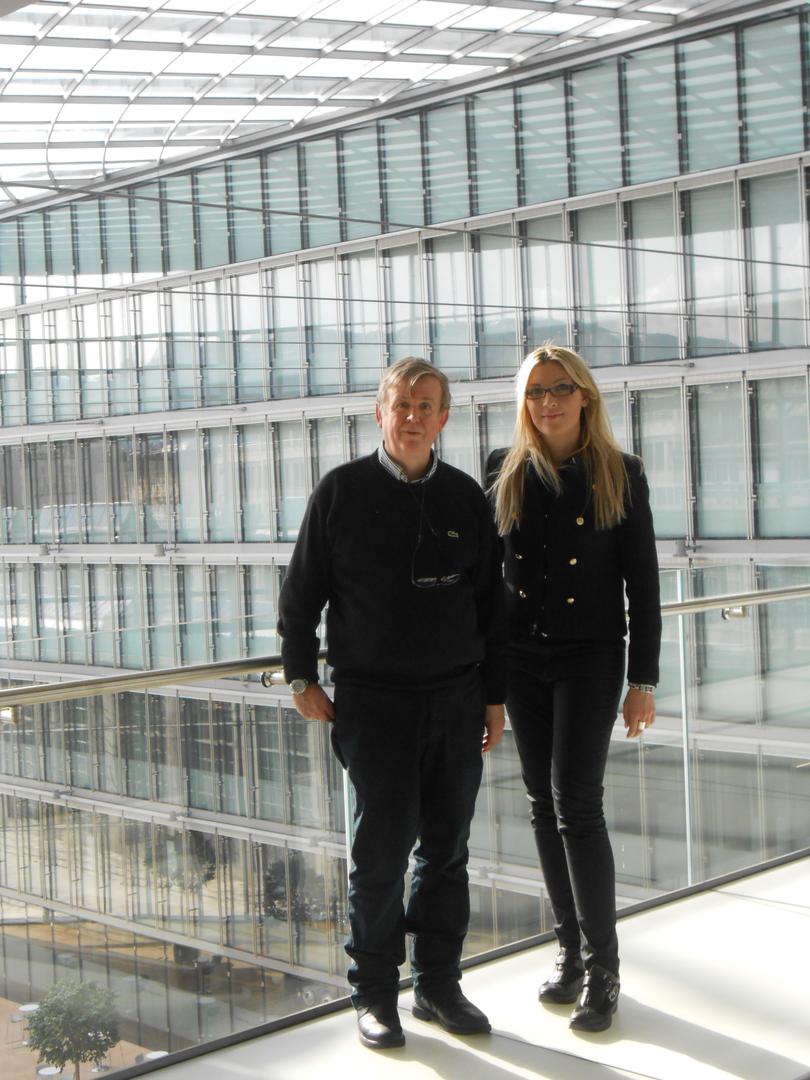
At the time of the interview, Richard Walker was the official spokesperson for the Human Brain Project (HBP), a senior scientific associate on the Blue Brain Project and a member of the HBP ethics committee. He spoke with Ivana Greguric about simulating the human brain, consciousness, responsible research and control over machines’ goals.
The conversation was recorded at Campus Biotech in Geneva on 24 February 2015. Statements, scientific data and predictions are presented in the historical context of the interview. The questions and answers are reproduced in full, with words and paragraphs split across pages rejoined.
What is the aim of the Human Brain Project?
The aim of the Human Brain Project is to build an entirely new ICT infrastructure for future neuroscience, future medical science and computing, which will catalyse a global collaborative effort to understand the human brain and its diseases and ultimately to emulate its functional capabilities. Emulating the brain means that today’s computers are very different from the brain: they can do some things much better than the brain, consume more energy and are less reliable. But, for example, there are many things a five-year-old child can do that a computer cannot. I can show a child a picture and the child will say it is a cat, but a computer cannot do that. We would like to take brain circuits, after examining those of mice, rats and ultimately humans, and put them on chips that could provide new designs for computer systems. So it would be a technological product you could use to build a computer.
How do you intend to create a functional artificial human brain, and will you succeed in achieving your goal by 2020?
Most of our efforts are directed towards creating the prerequisites for a human brain, based on rats and mice, which has helped us produce a draft digital reconstruction of neural microcircuits in the rat neocortex—just 30 thousand neurons. Considering that the human brain has 100 billion neurons, that is an enormous difference. Nevertheless, this is a significant achievement because it shows that a successful digital approximation of brain tissue is possible, a step towards simulating the entire brain. The main point is that we are developing generic tools that will enable simulation, and if we have human data, we can simulate any part of the brain of any species, including humans. I can say that we will achieve our goal for the HBP by 2023. Alongside the basic mapping technologies, we will try to achieve a simulation of the human brain. The maps we can produce by 2023 will still be incomplete, very imprecise and will not faithfully represent every aspect of the human brain. Biologically speaking, many things in the brain are duplicated: one neuron, one parameter or one cell is very similar to a parameter or cell elsewhere in the brain, even across different species. The same applies to synapses, certain basic circuits and so on. One major limitation is the enormous cost of computing power. We believe we have enough computing power to carry out the entire project, but we cannot do it because we lack the data.
What does the simulation require in terms of supercomputer hardware capacity?
The HBP supercomputer will be built in stages. The simulation requirements for supercomputer hardware and software capacity and data infrastructure are still being developed. We believe that by the end of the project we will have the computing power we need. So far, we have replaced computers every three years, and procurement of a 50-petaflop system for 2016/2017 is already under way. The ultimate aim of the project is to simulate all 100 billion neurons of the human brain at the cellular level. We are counting on having an exaflop supercomputer with 100 petabytes of memory before 2023.
Will this artificial brain have the same intelligence and consciousness as humans?
That is a philosophical question. Consciousness is still a major problem; we do not know exactly what consciousness is. If we use a common-sense notion to define awareness, we know it is connected to particular neuronal states. So we know that we have achieved synchronisation across the whole brain, in different areas of the brain, and have made unconscious people conscious, which does not happen in people under anaesthesia. Our models will definitely simulate the neural states that we regard as conscious states in animals and humans. Whether that makes them conscious or not is a major philosophical question that I do not know how we will test. Ultimately, it is really difficult. I think we have to make a public decision, and I am not sure it is a question that science today can really answer without models. Some people, such as Christopher Koch, who works at the Allen Institute for Brain Science and works with us, believe that computers can be conscious: any system with a sufficiently large complex of information can become conscious. And that includes computers. Other people say that is ridiculous, so it is a very controversial subject. I think the only thing we know is that we will produce synchronised neuronal states, and obviously we do not know anything else at this point.
Since innovation can raise many questions and dilemmas, there should be collective responsibility. Is responsible innovation part of the HBP?
We are responsible for our actions in society. We want to involve society. For example, we do medical work, and I think it is very important to involve patients and their families. We have certain laws we must obey, but that is relatively easy. The first thing we have to do, however, is build trust so that people are not afraid of us. The law does not require this, because there is no law saying we must discuss ethical and medical issues with patient groups. But if we want patients to contribute data voluntarily, I think we have to open this discussion; otherwise, they will never do it. We have three areas in the project: basic neuroscience, medicine and computing. All these areas have certain problems. In basic neuroscience, many people are frightened that we might do things that could harm people, but I think we need to talk openly so that people can understand what we are doing. Personally, I think it is very harmless and could reveal interesting things about what we are as human beings, but I do not think those are ethical questions.
How do you achieve responsible research and innovation in the Human Brain Project, and have you encountered any problems so far?
We will have difficulties; so far we have none because we are far from practical applications. The first aspect is legal responsibility. We have laws; that is a sine qua non. There are laws on animal experiments, laws on human experimentation, privacy laws and laws on informal consent; we must obey those laws. We have an ethics committee that monitors compliance with legal regulations to ensure that we follow the rules. Initially, we leave this to local boards and committees, because different countries in Europe have different rules and local committees decide on the basis of those rules. But in some cases, for example, we use data from China, so we will try to do everything to have them endorse European standards, meaning we will not conduct research in China if that research is prohibited in Europe.
The second aspect is talking to citizens about how these techniques should be used and what rules should apply. We are doing things with long-term consequences, so if, for instance, we succeed in developing computing, that could change the industry. When we introduced standard computers, it changed the industry, and if we make better computers, it will change the industry again and affect employment, competitiveness and many other things. But that is a long way off. If I build a new computer today, its economic effects will emerge 20 years later. So we have time.
But we have to discuss how to use data, because we would gain a great deal if we had access to all patient data in hospitals. Patients may not want that, however, so we must discuss the right way to obtain medical information while respecting patients’ rights. I do not think we can succeed if we propose a solution patients dislike. Secondly, we need ethical awareness ourselves, because public opinion matters, but I think that when scientists do scientific work, they understand some implications long before the public does, and they are more realistic: they know what is possible and are not worried about science fiction. So people within our project need to be aware of ethics. The Foresight Lab is a group at King’s College in London; they talk to people and try to solve problems before they occur. They examine different possibilities, such as whether a particular side effect could be caused and what might happen. All these things together constitute responsible innovation.
Do you think the results of the Human Brain Project could be used for non-therapeutic purposes, such as modifying neurons, or for military purposes?
We produce knowledge, and we produce technologies. It is completely impossible to stop knowledge from being used. So if you were interested in basic physics in 1929/1930 and understood how the atomic nucleus works, you were preparing Hiroshima but did not stop it. We therefore have a commitment within the project not to work directly with the military, but we have no illusions that this will prevent the military from using our work. I am not afraid of neuroscience, because I think the military will probably develop similar things themselves before getting them from us. I am more concerned about technology. A technology-inspired brain, a personal weapons system—there is no doubt you can use it negatively. But I think what we can do as scientists is inform people of the risks, and then there can be a societal, and even international, discussion about what we do and do not do. It is not true that science always turns into weapons, even when it is possible. As an international society, we have decided not to build bacterial biological weapons or chemical weapons, so society can decide that some things are so bad that we do not want them. What everyone fears is autonomous weapons systems. On the one hand, some technologies can contribute to that, but on the other, this has already advanced very far with today’s computing technology.
The real question is not so much the intelligence of neurotechnology, since today’s drones have a high level of intelligence with the ability to kill people autonomously, without human involvement. We need an ethical debate in society about whether this is acceptable, and scientists can help by informing the public. Science can play a crucial role by dispelling certain myths. But if the military wants to misuse our technology, it can do so; the same applies to intelligence agencies.
What strategies and methods do you have to prevent that?
It cannot be prevented. What we can do is raise public awareness and discuss it with the public, and collective public action can prevent things. By public action, we mean informing journalists, politicians, non-governmental organisations and so on. The military can use technology without its inventors knowing. But I think it is naive to say people will give up a generic technology: brain technology is extremely generic. It is like saying you will build an atomic bomb; it is used only to kill people, and you can say you do not want to make it. But if you say you will make a computer chip, computer chips are used everywhere: in mobile phones, washing machines and bombs. Is it really realistic to expect people to give up the chip? I do not think so. It is like a hammer: you can use a hammer to make a weapon, but hammers are also used for many other things. Are we really going to give up that power? No, that will not happen. I think we should begin a discussion and see what society really does not want. Society does not want to ban the hammer, and I do not think it wants to ban computer chips either. What we want to ban is a particular kind of use of the hammer and the chip.
The HBP compares aggregated clinical data that will be available to researchers worldwide under an open-data policy, which could raise many problems, such as informed-consent requirements, privacy and confidentiality. What are you doing to protect patient data?
This is an interesting subject. Our aim is to ensure that no one can identify individual data. The first thing we do is remove all personal identifiers so that you never find things showing dates of birth and so on. Secondly, we aggregate the data in a way that means the data actually remain in the hospital. For example, you are a researcher and want to know the size of a particular part of the brain, the hippocampus, in patients who have difficulty walking and a certain type of paralysis. You submit a query to find out those sizes. Our centre divides that query into a separate query for each hospital. The hospital then looks at its own data and identifies all patients who cannot walk or who have that type of problem. It then looks at the brain measurements and returns statistics on sizes, so you do not receive individual patients’ data. In this way, you receive data from each hospital, which we then aggregate. If a hospital has only one patient or a small number of patients with a particular condition, it refuses to answer and does not provide those data. So you cannot obtain them. But security researchers will say that under very particular conditions, and with a great deal of effort, you may still be able to obtain individual patient data. This raises questions about different ethical regimes. Some countries require it to be technically impossible to obtain the data; we cannot do that. Other countries say it must be impossible with reasonable effort, and we can do that. We can make it incredibly difficult to obtain any personal data. Ethically, I think that is enough.
There is no impossibility in science; nothing is impossible in science. So this also varies: even in countries where they say it is completely impossible, courts do not interpret it that way. But then the issue of credibility arises. We can discuss interpretations of the law, but there are also cases, for example in the United Kingdom, where hospitals did things that were perfectly legal but caused a huge uproar. They had a project called “Cared for in the United Kingdom”, similar to ours; they wanted to collect hospital data and use them for research. Under British law, this is perfectly legal. But there was a major scandal, patients said “no”, and they had to cancel a project that had cost them a hundred million. So I think the real answer is that acting within the law is necessary but insufficient. The real issue is that we must win the trust of patients and their representatives. If we achieve that, then we are doing the right thing.
What might be the project’s greatest potential danger, and what ethical issues has the Society and Ethics Programme (SEP) Steering Committee discussed since the project began?
I am not particularly afraid. We have discussed two major ethical issues so far, and a third is coming up. The first and greatest problem we have is medical informatics, particularly questions of privacy, informal complaints and data confidentiality. This is a real problem because Europe is currently drafting a new data-protection regulation, and that will affect us. We do not know what this regulation contains, but it has prompted a major debate. The research team is under pressure over what is called a research exemption, which means we can use anonymous data without the possibility of informal complaints. Courts dealing with privacy issues believe there should not be such an exception. What we are doing is definitely legal. But that is not enough for trust. The second issue for discussion is dual use; that will not be urgent for the next 5–10 years, so we have time. Privacy and data protection are immediate problems; that is our priority. But our ethics committee has formed a special working group on dual use. We should not delude ourselves that we can stop dual use, but we must at least be aware of it. The third problem is employment and the economy. Again, however, I am not sure whether these are general issues for computer technologies and to what extent they are specific to our work at all, but we certainly contribute to them. There is absolutely no guarantee that jobs that may disappear will be replaced, but I do not think we can change that. So the real question is how we can build society and these conditions. This is a general sociopolitical debate; it is not a debate for the HBP alone, and it will happen even if our project does not fully succeed.
One member of the Ethics, Legal and Social Aspects committee is Julian Savulescu, director of the Oxford Uehiro Centre for Practical Ethics, who defends cognitive enhancement. How do his arguments about human enhancement fit into the Society and Ethics Programme and the methods developed during research into new technologies?
Of course, if you are an ethicist, you will have views, but every individual has their own views. We hope to have a committee comprising different people with different perspectives. If you do not have different perspectives, you are not thinking about it, and we try to ensure a diversity of views. I do not see that as a major problem. We have religious and non-religious people, scientists and lawyers—a varied mix of people.
You mentioned a human-brain chip. The Swedish high-tech company Epicenter implants computer chips beneath its employees’ skin, enabling interaction with technology (access through security doors, payments). Previously, this chip was used for therapeutic purposes (to treat Parkinson’s disease), but it can be used for tracking and includes the employee’s ID. How do you think this can be addressed?
At the moment, you have a certain level of protection because they do not have a long range, making them difficult to use for surveillance. This is new to me, but I think there must be rules on acceptable and unacceptable uses. This is another case of a generic technology: RFID chips are essential. I use one in my badge to enter this building, for contactless payments and for identifying luggage at the airport; supermarkets use them to track stock. So if you think we will abolish RFID, that is a myth; it will not happen. The next ones will be even better and more powerful. So I do not think banning the technology is the solution, but we can declare certain uses illegal. For example, it is like saying the NSA reads my email: are we going to ban email because of that? No! But we can make mass email surveillance illegal. So that would be my approach. If employees are excessively controlled in certain respects, I would make that illegal. Personally, if an HBP department accesses your Facebook account, or people in the United States demand that you give them your password, I would send them to prison, but I would not ban Facebook. That explains the path of the cyborg. It is a fairly harmless technology, but we can imagine a worse scenario.
I advocate establishing a new philosophical and ethical discipline, cyborgoethics, which would establish an intersubjective dialogue with philosophers and scientists, open to public debate about limits on implementing artificial technology in human beings. Are scientists in the technical sciences ready for such a dialogue?
I am not an ethical realist, so I do not believe there are ethical goods we can discover with a kind of “ethics meter”. I think we decide what kind of society we want to live in, and that is collective. I cannot decide on my own just as I wish, because I have to consider your needs, and we must discuss it together. On some things, we want to impose our moral rules; on others, we want to impose laws. If you want to implant something strange in your head, I really do not want to stop you, but I certainly want to do everything possible to prevent the HBP from forcing you to do it.
Do you think it would be important to create a framework of ethical norms for regulating the pervasive cyborgisation of human beings, which could lead to interest groups remotely controlling people and their movements, health and behaviour, or even developing communication and information viruses inside the human body? How do you think this can be prevented in the future?
For me, the major ethical issue in today’s technology is automation of the kind used in industry abroad, across all sectors of the economy and in services. It is easy to imagine that in 10 years you will be served by a machine at McDonald’s: you will simply say you want a Big Mac, and a Big Mac will come out of a box. This cannot be prevented. The first question is whether we want to prevent it at all. As I said, this is not something an ethicist can decide; it is something we as a population can decide. So, as citizens, do we want to retain lower-level jobs that are easily automated, lower-level jobs that are dangerous? Today, for example, if you go to a car factory, you no longer need workers in the paint shop because robots are there instead. That is probably a good thing because those workers died; they developed cancer. That is one good reason. But if we are going to replace a bus driver, what do you think about that? It is probably safer; will they make the technology safer? We have autopilots in aircraft, and we have agreed that they are much safer than pilots. But what would we not approve of? Although predictive medical technology is good, I probably want to speak to a real doctor, because I want to discuss what I want. The doctor tells us what we can do and what the side effects are, but do I want to be left alone with that, or do I want to speak with a human being who can influence my decision? So this is not merely a scientific question. This is the kind of decision about automation that we have to make.
Robotic evolution will change our world. Do you think intelligent robots will surpass humans in the future?
For me, the major ethical problem is decision-making by machines. When I use a machine as a tool, pilots who occasionally make decisions are in a fairly safe position. The autopilot sets the route, and we become comfortable with that, but the pilot can take control. However, how much control are we willing to give machines? I do not think this has anything to do with brain technology; we can give control to machines with our current technologies. And sometimes we like that. There are other things that will make us uncomfortable, such as drones deciding when to kill, or a robot police officer deciding when to shoot. I think we would not want medical decisions to be entirely automatic.
Could you comment on this quotation from the philosopher Berdyaev’s essay Man and Machine: “Man said to the machine: I need you to make my life easier, to increase my strength. And the machine replied to man: But I do not need you. I will do everything without you, and you may perish.” Will robots be able to evolve, and how will we control them?
That is a complete machine, so there is another philosophically interesting issue: who decides the machine’s goals? As long as we control the machine’s goals, we still have control. An autopilot has a very clear goal: to take the aircraft from point A to point B along a predefined route, bring it there safely and deal with emergencies that may arise. I think most of us agree with that. But now suppose the aircraft has the right to decide: I really do not want to go to Athens; I want to go to Ankara. Would losing control over the goals truly upset you? We could build technology to do that today. We will not, because no one can see the point of it, but there are no technological constraints that would prevent it.
Computers can change their own code. We do not do that because engineers like machines that they control and that are predictable. If you allow machines to change their goals and modify their own code, it becomes almost impossible to predict what they will do, and engineers do not like that. So we have good engineering reasons not to do it. But, for example, if we make machines that will evolve, or artificial organisms that will evolve, evolution is beyond human control.
If I create a genetically modified organism, modify it and release it into the environment, I maintain that it is mathematically impossible to predict where it will go. Unless it is designed to die in 30 minutes; that one is fairly safe. But evolution could eliminate even that mechanism. So, for me, the moment we lose control over the machine’s goals, we have crossed a line. As long as we have machines as tools that help us, we are safe. Also, although it is technologically possible to make machines that set their own goals, I cannot see a scenario in which that will happen. Why would we do it? I cannot see who would intend to do that.
Recently, Stephen Hawking has issued many warnings that the future development of artificial intelligence could have the potential to eradicate humanity. Do you take that fear seriously?
It is not intelligence that worries me, but goals. As long as we control a machine’s goals, I am happy and relaxed. If we lose control over machines’ goals, I am no longer happy, and I see no reasons why we should. But our risk does not really lie in the danger of our technology or artificial intelligence; it is a risk of computers as a whole. We can lose control in a nuclear reactor, and that has nothing to do with smart technology. I am concerned about losing control, but I think it is a general technological problem; I do not think artificial intelligence is the main issue.
How can we bring it under control?
Engineered systems are under control. There are two kinds of control. I am talking about control over goals. I can make a Google car that is badly programmed and goes haywire in some situations, or an aircraft autopilot that stops working properly for a few seconds. That is not the kind of lack of control I mean. That is just bad engineering. What frightens me is losing control over machines’ goals, where machines can set their own goals, and that is frightening. But it has not happened. We do not have it! We could do it! Tomorrow I can build a machine that will do it!
How can you do that?
Well, it is easy! You make a small function so that the machine—let us take a little robot that has to move to reach a goal, without doing anything nasty, just going to the goal and saying “Hello”—lights up when it reaches the goal. To do that, it has a defined goal in its memory, which I enter myself, and as long as I enter it, the robot is under my control. If I change it and add a function that says choose a location at random and make it your goal, then the robot is no longer under my control. I have lost control. I can do that in five minutes on this computer. It changes control without any intelligence whatsoever. There is no intelligence in it.
Are there any ethical consequences of simulating the human brain, and what consequences could it have for humanity?
The Human Brain Project has five strands within the Society and Ethics Programme (SEP): the Foresight Lab, which creates scenarios of possible developments; Conceptual and Philosophical Analysis, with an initial focus on simulations; Public Dialogue with interested stakeholders; Awareness Research to encourage ethical reflection among HBP researchers; and Governance and Regulation by an independent ELSA committee working with national ethics committees in Europe. The HBP is committed exclusively to civilian research, and it also has an open-data policy. All partners have committed not to accept military funding or use the data and knowledge acquired for military purposes. There are certain ethical issues concerning the military and “dual use”, such as memory modulation; monitoring, increasing and enhancing brain capacity; mind-reading in counterterrorism; mind control; and an enhanced robotic combatant.
Source and first publication
The in-person interview was recorded on 24 February 2015 at Campus Biotech, during Ivana Greguric’s fellowship at the Brocher Foundation in Geneva. It was first published in the book Kibernetička bića u doba znanstvenog humanizma – Prolegomena za kiborgoetiku.
Ivana Greguric, Kibernetička bića u doba znanstvenog humanizma – Prolegomena za kiborgoetiku, pp. 339–348.
English translation of an archival interview. Views and predictions are those of the interviewee and refer to the date of the conversation.