
FROM THE ARCHIVE · 14 April 2017
Ian Pearson: Digital immortality by 2050
Interview by Ivana Greguric
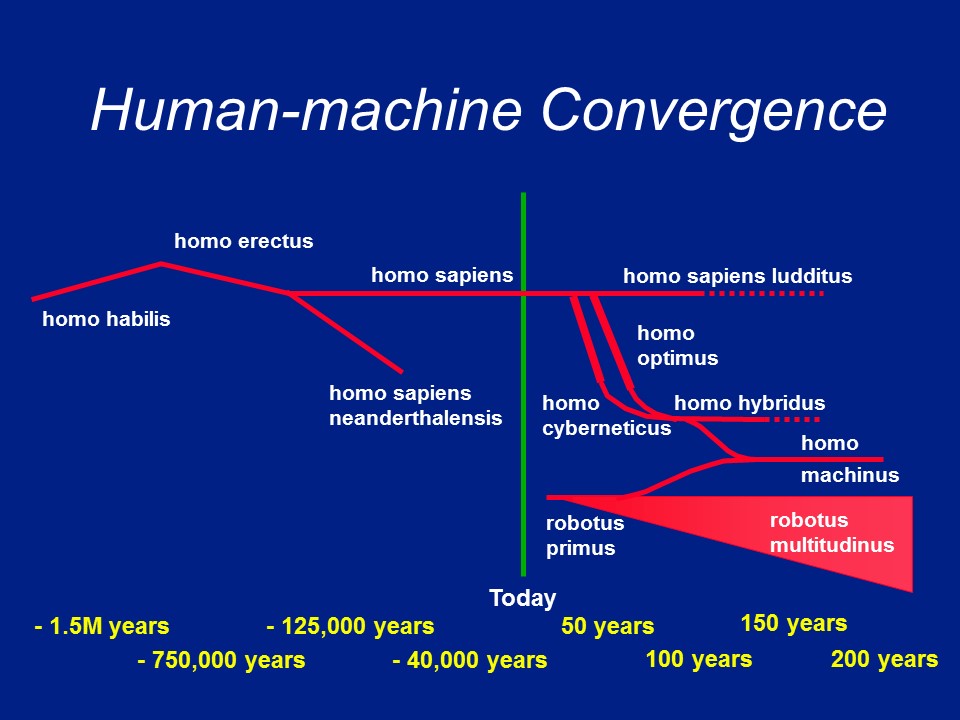
In this conversation, Ian Pearson presents his predictions about connecting the human brain to computer networks, digital immortality, relationships between humans and robots, and the ethical limits of technologically altering human beings.
This interview was conducted by email on 14 April 2017. Statements and predictions refer to the time of the conversation.
You predict that by 2050 Homo sapiens will evolve into Homo optimus. Can you explain what that will look like and how we will achieve digital immortality?
By 2050, we should know enough about genetic engineering to optimise it for the traits we want. I call this the human variant Homo optimus. At roughly the same time, or even earlier, we will probably be able to connect our brains to machines and networks, resulting in the emergence of Homo cyberneticus. These two types are not mutually exclusive, so you could have optimised genetics and be connected to the network, resulting in Homo hybridus. If your brain is connected to an IT network superior to the one in your brain, as will be the case, then your thoughts will mostly take place outside your head, and when your body dies, you will lose only a small part of your mind and memories. This implies a kind of electronic immortality, although even that would end if the machines were destroyed or switched off. Indeed, if you are currently under 40, the most likely cause of your death will be a machine being switched off.
You predict that in the future we will need a “digital bubble” to protect us from unwanted electronic information from chips. Can you tell us more about that?
In an internet-saturated world that bombards us with marketing information all day, we will need smart filters that let through only what we want. We would also use them to transmit some information about ourselves, but again, only the information we want to send at that moment and only to particular people or devices. It would be like a digital bubble, full of useful information relevant to your current situation, allowing useful data to flow while preventing all other data from reaching you.
What do you think about sexual relations between humans and robots; do you think emotional relationships with robots will be possible in the future?
Artificial intelligence will become emotionally capable in the foreseeable future, and robots using that artificial intelligence will be able to make friends with humans and other robots. Sometimes people will fall in love with their robot assistants and lovers; indeed, this will be perfectly normal once they begin responding in a human way. Not all robots will be equipped for sexual relations, but if someone spends 20–30 thousand euros on an android, they will probably have no problem paying a few hundred more to get an android that looks the way they want and has the appropriate sexual features. By then, it should be possible to connect to your nervous system, so android lovers should be able to discover which sensations you enjoy and provide them to stimulate you, or even stimulate your nerves directly. Sex with a robot could be the best sex of your life.
According to your predictions, people will be able to communicate telepathically from anywhere in the world through some kind of global server networked with the brain. What is a networked brain, and how could this be achieved (by implanting a chip in our brain, or otherwise)?
If your brain and another person’s brain are connected to a network, you will obviously be able to communicate telepathically with each other directly. It will be possible to connect to every neuron, every synapse in your brain, and this definitely requires nanotechnology and will not be possible for some time. But establishing a connection with the brain is feasible by 2045–2050, so telepathy could become the norm after that, with shared minds, shared consciousness and even shared bodies.
In my book, I advocate establishing a new philosophical and ethical discipline (cyborgoethics) that would establish an interdisciplinary dialogue between philosophers and scientists, open to public opinion, to discuss limits on implementing artificial technologies in human beings. Do you think we need a framework of ethical norms to regulate the pervasive cyborgisation of human beings and the remote control of people’s movements, health and behaviour by interest groups?
Yes, I think there needs to be a great deal of informed discussion about the capabilities of these technologies so that society can make an informed decision about rules and limits for individuals, companies and even governments. We do not want the government to control us electronically. Some large IT companies have already begun regularly discussing these issues, but considering their sometimes questionable behaviour and often strong political leanings, I certainly do not trust today’s IT companies to do this for us. If they themselves cannot behave ethically in areas such as taxation or mapmaking, how could we trust them not to put their profits ahead of our well-being?
What can we expect in the near future?
Well, quite a lot, but the most important near-term trends are artificial intelligence and augmented reality.
Source and first publication
The interview was first published in Ivana Greguric’s book.
Ivana Greguric, Kibernetička bića u doba znanstvenog humanizma – Prolegomena za kiborgoetiku, pp. 356–357.
English translation of an archival interview. Views and predictions are those of the interviewee and refer to the date of the conversation.