
FROM THE ARCHIVE · 25 November 2016
Amal Graafstra: You can become a cyborg for just a few dozen dollars
Interview by Ivana Greguric
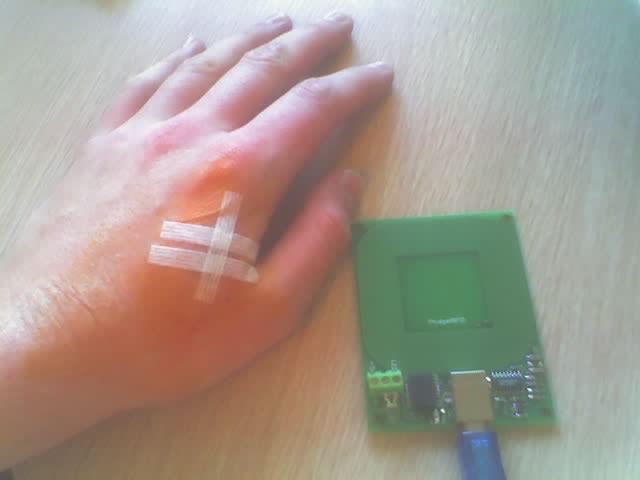
Amal Graafstra is the founder of Dangerous Things and the author of RFID Toys. In this conversation, he discusses his own experience with implanted chips, connecting biological and digital identity, and his understanding of the ethics of technologically modifying the body.
This interview was conducted by email on 25 November 2016. Statements and predictions refer to the time of the conversation.
Why did you start hacking?
In 2005, I implanted two RFID chip transponders, one in each hand. I did this so I could unlock and open the doors to my offices without keys. Since then, I have written a book called RFID Toys and founded the biotechnology company Dangerous Things.
Can you tell me more about your experience after having a chip implanted?
After the implant was inserted, my sense of self changed. When technology is well designed and transparent, meaning that it requires no management (for example, there is no battery to recharge), and is permanently implanted, it becomes part of your “expectation of capability”. Just as you expect to be able to use your hand to reach for a pen, or your legs to walk, or even expect your heart to be beating when you wake up in the morning—these are “expectations of capability” that are not quite the same as expecting to check Facebook on your mobile phone. I now expect to be able to talk to machines, convey a form of digital identity to them, and thus open doors, log in to my computer and start vehicles without needing an external device. The chip that authorises my access is now part of me and who I am.
In your opinion, will hacking be the next stage of evolution?
Evolution is a combination of two things: mutation and selection. As society advances, it tends to eliminate certain kinds of selection. When a child is born with a heart defect, doctors perform surgery to repair it. Medicine and technology allow people to die of natural causes at increasingly advanced ages. Until now, however, mutation as a driver of evolution has been random. Typically, mutation produces negative outcomes, diseases, but sometimes it results in a new trait, genetic characteristic or ability that is beneficial in the environment in which people currently live. We are in a position to guide and determine our own traits, characteristics and capabilities. Genetic modification and design are now possibilities in our lifetimes, and we can also enhance our human capabilities by directly implanting technology.
Do you think evolution will take a different direction if people begin using implants on a large scale and start adapting, but eventually lose their functions or acquire new ones?
Yes. Once we can determine our own evolutionary paths, human beings will begin to diverge along separate evolutionary paths. I do not foresee a time when people will lose functionality, but I definitely think there is a need to improve ourselves and expand our capabilities.
How many people have had your devices implanted, are any of them from Croatia, and what is the long-term business plan for this technology?
Several thousand people have had our products implanted. So far, not a single chip has been ordered from Croatia. We are now working to connect a person’s biological and digital identities using cryptographic implants. Vivokey is our current project.
Did you seek ethical approval before putting the chips on the market, and has any ethics committee contacted you since then?
No ethical approvals were required, just as new body-modification jewellery does not need ethical approval. People form their own personal ethics around whether or not it is appropriate to use technology. I do not make assumptions for people, nor am I arrogant enough to pretend I know what is best for other healthy adults when it comes to their own bodies. Ethics applies in cases where an adult is under duress, usually because of medical problems or complications. That is not a healthy adult who can independently make objective decisions, and that is where ethics committees need to step in. We do not deal in medical devices and therefore do not need ethical approvals.
Where do you see the future of NFC chip use, beyond the arms industry (an RFID smart gun)?
Honestly, I do not see much of a future in it. Perhaps in other countries, but not in the United States. I think the main reason gun owners dislike smart guns is that they fear the gun will not work because the technology fails or circumstances prevent it from working. Having an implant is the only way to guarantee that you will always have the security device needed to unlock a firearm. Others have used biometrics, such as fingerprint scanning, but these were slow to authorise and often require several attempts to authorise legitimate users correctly.
Source and first publication
According to the note in the book, it was published in Večernji list on 28 November 2016.
Ivana Greguric, Kibernetička bića u doba znanstvenog humanizma – Prolegomena za kiborgoetiku, pp. 353–355.
English translation of an archival interview. Views and predictions are those of the interviewee and refer to the date of the conversation.