
 Visual: Digital Logos Design
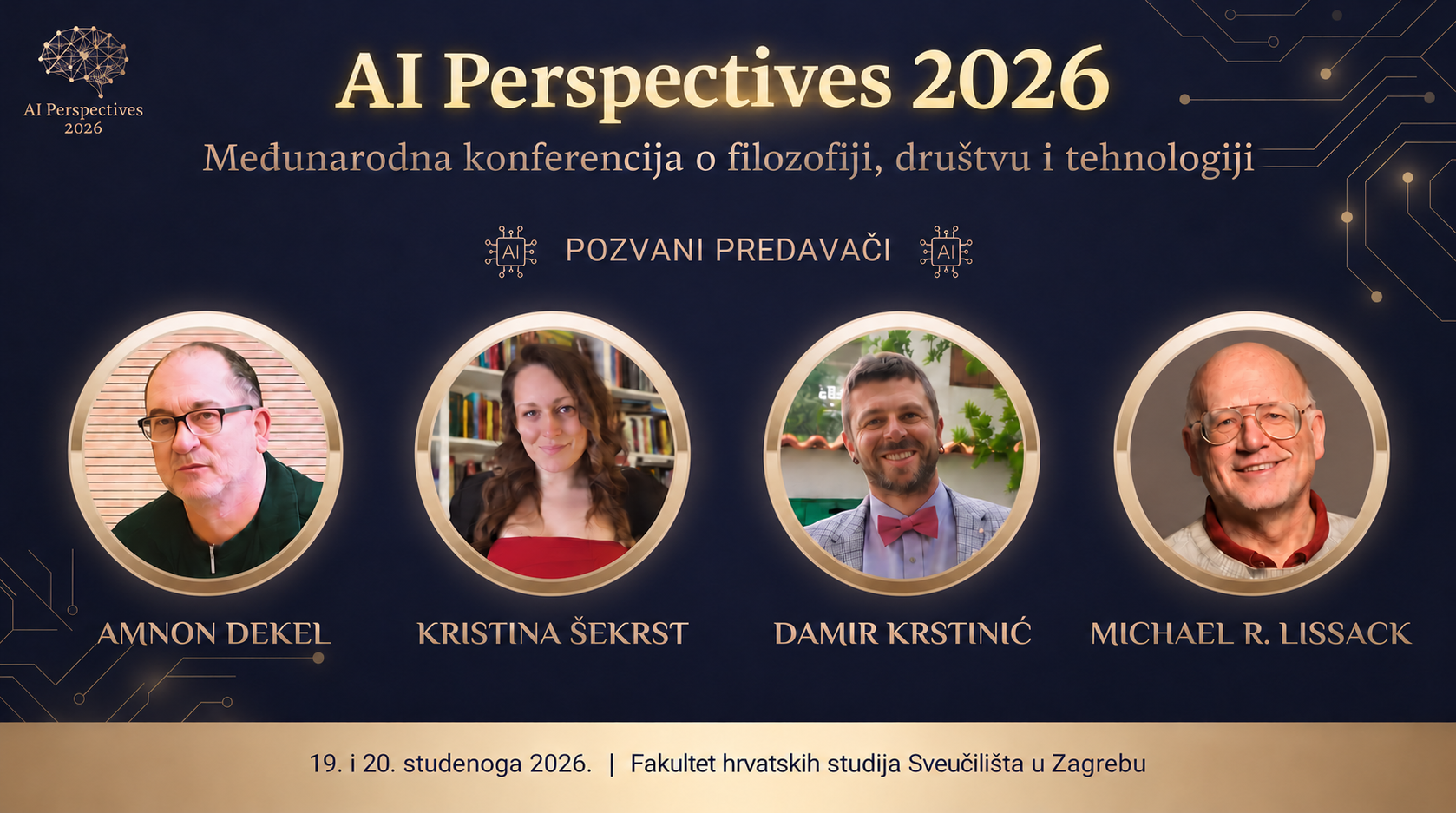
How is AI changing work and education? What can we infer from a language model that says it has feelings? To mark World Philosophy Day, the University of Zagreb’s Faculty of Croatian Studies will welcome Croatian and international researchers and practitioners on 19 and 20 November for AI Perspectives 2026: Philosophy, Society and Technology.
The keynote speakers are Amnon Dekel, Kristina Šekrst, Damir Krstinić and Michael R. Lissack. Their talks share a question about human judgement. What can we reliably infer from a system’s output, and who takes responsibility for decisions based on it?
Keynote lectures
Amnon Dekel
Intersections Between AI and Human Behavior: Toward Human-Centered Principles for an Age of Accelerating Disruption
Dekel, from the Hebrew University of Jerusalem, examines how rapidly generative AI is changing everyday life, organisations and labour markets. He considers how people find meaning in work, how much freedom they have to act and how technological change affects social stability. What principles would put people at the centre of this change?
Kristina Šekrst
Who Put I in AI? Five Neurons and the Philosophy of Mechanistic Interpretability
How much can individual circuits tell us about a large language model as a whole? Šekrst asks how training and post-training shape statements such as “I feel” and “I am conscious”. She examines whether these claims provide evidence of machine consciousness and why researchers looking for signs of consciousness may draw broad conclusions from limited findings.
Damir Krstinić
AI on the Fire Line
Krstinić, from the University of Split, will present a Croatian wildfire detection system developed over more than two decades. It analyses footage from nearly 300 cameras at almost 150 locations. Drawing on an expanding archive of real fires, he will show how the system supports firefighters from detection through response. Trained professionals assess conditions, make decisions and direct interventions.
Michael R. Lissack
Always Question: Trustworthy Human–AI Collaboration as the Contesting of Ground
Lissack, from Tongji University in Shanghai, asks what makes human–AI collaboration trustworthy beyond accuracy, robustness and explainability. His principle of “always question” asks people to examine the grounds for a system’s claim, its assumptions and the consequences of acting on it. People retain responsibility for decisions that follow.
Programme and visitor information
The two-day programme brings together philosophy, computer science, psychology and sociology. Discussions cover AI reliability and ethics, its effects on education, the economy and society, and the evolving relationship between people and technology. Early-career researchers and students can present their research and exchange ideas with colleagues from academia and industry.
The opening ceremony takes place at 9 am on Thursday 19 November in the Zagreb Main Hall. The rest of the programme takes place in the Faculty library on the Borongaj Campus, Borongajska cesta 83d, Zagreb. Admission is free and no advance registration is required.
Conference programme (PDF) · Book of abstracts (PDF)
Sources
AI Perspectives 2026 — keynote titles and abstracts
Faculty of Croatian Studies — conference announcement, 16 November 2026